
Ultimate Guide to Training Contracts in Birmingham
Explore key insights into securing training contracts in Birmingham, including top firms, tips for applications, and how to stand out in this vibrant market.

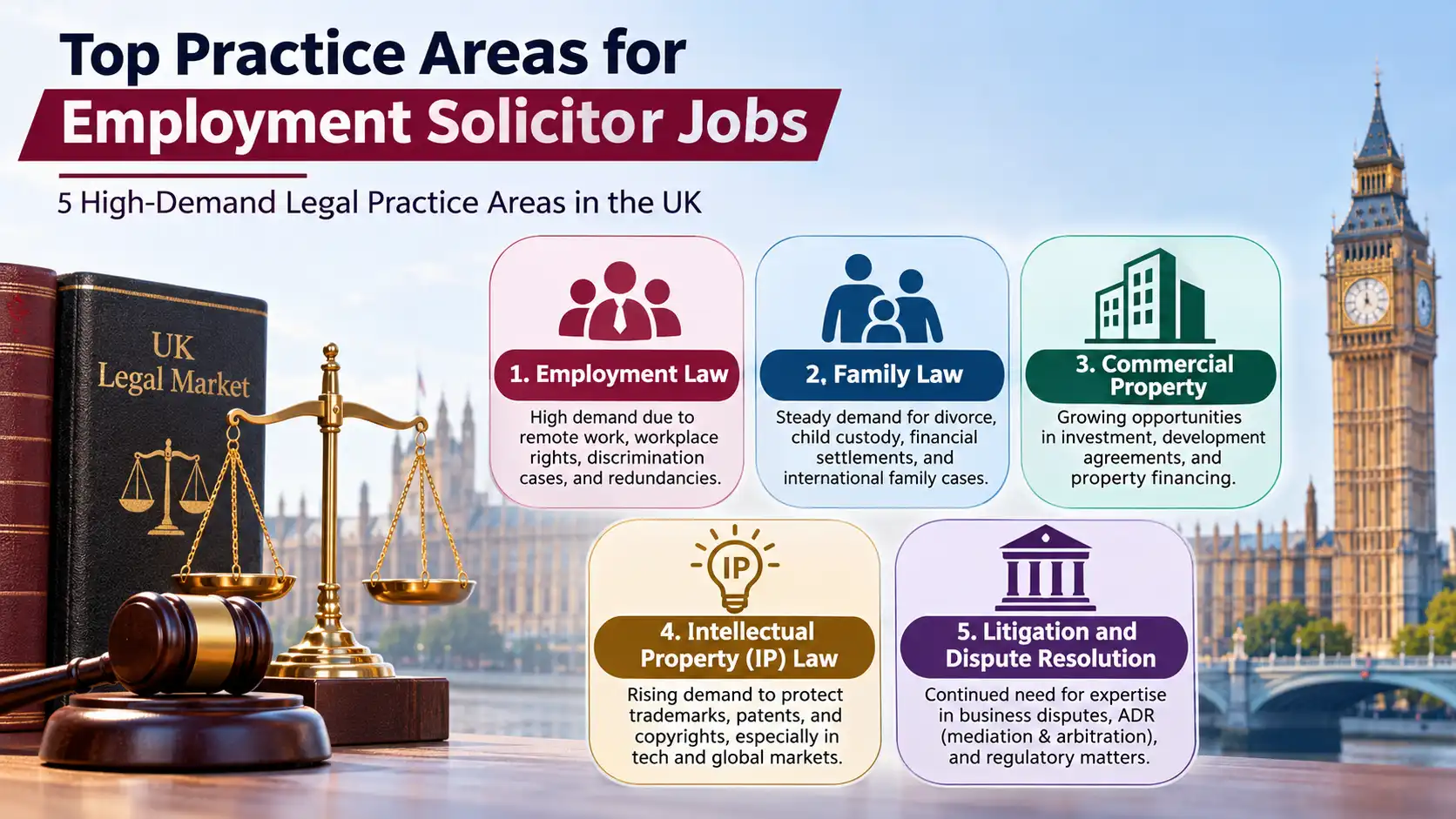
The legal profession offers a wide range of career opportunities for solicitors across different practice areas. From advising businesses on commercial transactions to helping individuals resolve personal legal matters, each specialism requires distinct knowledge and skills. For solicitors considering their next career move, understanding the nature of work within different practice areas can help identify opportunities that align with their experience, interests and long-term career goals.
Employment law is an established practice area within the UK legal sector, with solicitors advising employers and employees on workplace rights, contractual obligations and employment disputes.
Employment solicitors work in private practice, in-house legal teams and organisations providing specialist employment advice. Opportunities exist for lawyers with experience in both contentious and non-contentious employment matters.
Employment Contracts and Workplace Policies: Solicitors advise on employment contracts, workplace policies, restrictive covenants and employers’ statutory obligations.
Discrimination and Harassment: Employment lawyers advise on claims involving discrimination, harassment and victimisation under the Equality Act 2010, as well as measures to prevent unlawful conduct in the workplace.
Redundancy and Dismissal: Solicitors assist employers and employees with redundancy procedures, settlement agreements, unfair dismissal claims and other employment termination issues.
Employment Law Reform: Legislative developments, including the Employment Rights Act 2025 and its phased implementation, create advisory work for solicitors helping organisations understand and comply with changing requirements.
Employment solicitors benefit from strong negotiation skills, a sound understanding of employment legislation and the ability to advise on both workplace disputes and preventative legal measures.
Family law covers a broad range of legal matters affecting individuals and families, including divorce, financial arrangements, children disputes and domestic abuse.
Solicitors practising family law may work in specialist family law firms, larger multidisciplinary practices or organisations providing legal assistance to individuals.
Divorce and Financial Settlements: The Divorce, Dissolution and Separation Act 2020 introduced no-fault divorce in England and Wales in April 2022. Family solicitors continue to advise clients on divorce procedures, financial remedies and the division of matrimonial assets.
Children Matters: Solicitors advise on child arrangements, parental responsibility and disputes concerning children’s welfare. These matters are governed primarily by the Children Act 1989 in England and Wales.
Domestic Abuse: Family lawyers assist clients seeking protective measures, including non-molestation orders and occupation orders, where appropriate.
International Family Law: Cases involving families across different jurisdictions may require advice on international child abduction, relocation and the recognition or enforcement of foreign court orders.
Family law requires strong communication, negotiation and client-care skills. Experience in financial remedy proceedings, children matters or complex family disputes can support career development within this practice area.
Commercial property solicitors advise businesses, investors, developers, landlords and tenants on transactions and legal issues involving commercial real estate.
The volume and type of work available can vary according to property market conditions, investment activity, financing costs and development projects.
Commercial Leases: Solicitors negotiate and draft leases, agreements for lease, licences and other documents relating to the occupation and management of commercial premises.
Property Acquisitions and Disposals: Commercial property lawyers conduct due diligence, investigate title, negotiate transaction documents and manage the legal aspects of buying and selling commercial property.
Development Projects: Solicitors advise developers, landowners and investors on development agreements, land acquisitions, planning-related obligations and property arrangements associated with construction projects.
Real Estate Finance: Commercial property lawyers assist lenders and borrowers with property-backed lending, security documentation and legal due diligence.
Solicitors with experience in commercial leasing, property transactions and development work may find opportunities in commercial law firms, property-focused practices and in-house legal teams.
Intellectual property law concerns the protection, ownership, exploitation and enforcement of rights in inventions, brands, creative works and designs.
IP solicitors advise businesses across sectors including technology, life sciences, manufacturing, media, entertainment and consumer products.
Trade Marks and Brand Protection: Solicitors advise on trade mark registration, licensing, infringement disputes and the protection of commercial brands.
Copyright and Design Rights: IP lawyers assist clients with ownership, licensing and infringement issues relating to copyright-protected works and designs.
Patents and Technology: Solicitors advise on patent licensing, commercial agreements and patent disputes, often working alongside patent attorneys and technical specialists.
IP Commercialisation: Businesses require legal advice when licensing, assigning or transferring intellectual property rights, particularly in commercial transactions and collaborative projects.
IP Disputes: Solicitors represent clients in disputes involving alleged infringement, misuse of confidential information and other intellectual property matters.
IP law is a specialist field, and relevant opportunities depend on a solicitor’s experience and the nature of the firm’s practice. Knowledge of IP legislation, commercial agreements and dispute resolution can be particularly valuable.
Litigation and dispute resolution solicitors advise individuals, businesses and organisations on resolving legal disputes through negotiation, alternative dispute resolution and court proceedings.
The practice area encompasses several specialisms, including commercial litigation, professional negligence, property disputes and civil fraud.
Commercial Disputes: Solicitors handle disputes arising from contractual obligations, shareholder arrangements, business relationships and other commercial matters.
Professional Negligence: Litigation lawyers advise clients on claims involving alleged breaches of professional duties and the resulting financial losses.
Property Litigation: Solicitors assist with disputes involving commercial leases, possession, dilapidations, rights over land and other property-related issues.
Alternative Dispute Resolution (ADR): Mediation, arbitration and other dispute resolution methods can provide alternatives to court proceedings. The appropriate approach depends on the dispute, the parties’ objectives and any applicable contractual provisions.
Regulatory and Civil Disputes: Some litigation practices also handle disputes involving regulatory decisions, investigations and civil enforcement proceedings.
Litigation solicitors require strong analytical, drafting, negotiation and case-management skills. Experience in procedural rules, evidence, settlement negotiations and dispute strategy is important for progression within this field.
Each of these five practice areas offers different opportunities for solicitors, depending on their qualifications, experience and professional interests. While recruitment activity varies between firms, locations and market conditions, developing specialist knowledge and relevant practical skills can help solicitors pursue suitable roles.
Whether you are looking to build experience in an established specialism or considering a move into a different area of law, researching current vacancies and understanding employers’ requirements are useful steps. Exploring solicitor jobs across different practice areas can help you identify positions that match your expertise and support your long-term career development.

Explore key insights into securing training contracts in Birmingham, including top firms, tips for applications, and how to stand out in this vibrant market.
Explore the best cities in the UK for crime solicitor jobs. Learn about local markets and career growth opportunities.
This 2026 guide explores charities solicitor jobs, salary expectations, qualifications, essential skills and career progression in the UK. Whether you are a newly qualified solicitor or an