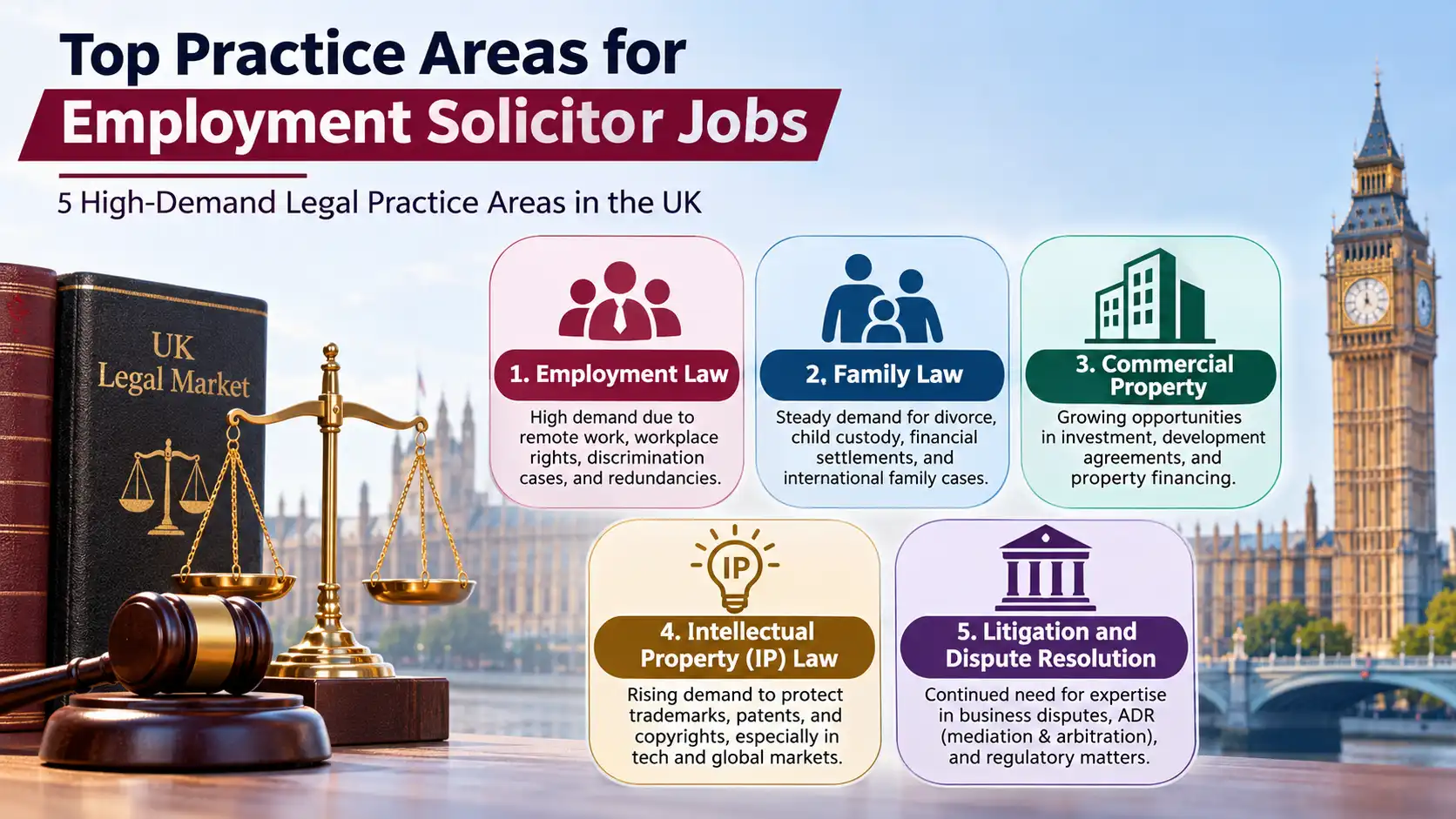
Top 5 Practice Areas for Solicitors in High Demand
Explore the most sought-after legal practice areas in the UK, including employment law, family law, and commercial property, to guide your career path.


Employment law has become an increasingly important area of legal practice in the UK. From workplace discrimination and unfair dismissal claims to employment contracts and organisational restructuring, businesses and individuals regularly need specialist legal advice.
For qualified solicitors and legal professionals considering their next career move, employment law offers opportunities across private practice, in-house legal departments and specialist employment law firms.
But what is driving demand for employment solicitor jobs in the UK, and what should candidates expect from this area of practice?
Employment law affects almost every organisation with employees. As workplace expectations change and employers face new compliance responsibilities, specialist legal support remains essential.
Several developments are influencing recruitment in this sector.
Employment legislation continues to evolve, creating ongoing advisory work for employment solicitors.
The Employment Rights Act 2025 and its phased implementation are particularly relevant to employers reviewing their workplace policies and procedures. Changes relating to employment protections, statutory rights and workplace practices require careful legal interpretation.
Employment solicitors help organisations understand which requirements are already in force, prepare for future commencement dates and reduce the risk of employment disputes.
Discrimination, harassment, unfair dismissal and whistleblowing remain important areas of employment litigation.
Employees may seek legal advice when they believe their statutory rights have been breached. Employers also require representation when responding to tribunal claims or attempting to resolve disputes before formal proceedings.
Solicitors with experience in employment tribunals, settlement agreements and dispute resolution can therefore bring valuable expertise to legal teams.
Hybrid working, flexible working requests and workplace adjustments continue to raise legal questions.
Employers must consider statutory obligations while balancing operational requirements. Employment solicitors advise on flexible working procedures, contractual arrangements, reasonable adjustments and the handling of workplace grievances.
These matters create opportunities for lawyers who can combine technical legal knowledge with practical commercial advice.
Organisational changes can involve difficult employment decisions.
Businesses undergoing restructuring may need legal guidance on redundancy consultations, collective consultation obligations, settlement agreements and changes to employment contracts.
Experienced employment solicitors help employers manage these processes lawfully while advising employees on their rights and available options.
An employment solicitor advises employers, employees or both on legal matters arising from the employment relationship.
Responsibilities vary depending on the firm, client base and level of seniority.
Typical duties include:
Drafting and reviewing employment contracts, workplace policies and settlement agreements.
Advising on unfair dismissal, discrimination, redundancy and disciplinary procedures.
Representing clients in employment tribunal proceedings.
Negotiating settlements and resolving workplace disputes.
Supporting HR teams with employment law compliance.
Advising businesses on restructures, transfers of undertakings and workforce changes.
Keeping clients informed about relevant legislative developments.
Some solicitors specialise in contentious employment law, while others focus primarily on non-contentious advisory work. Many positions involve a combination of both.
Employment law offers several career routes, depending on professional experience and preferred working environment.
Law firms recruit employment solicitors to advise corporate clients, individual employees or both.
Private practice roles may involve managing an independent caseload, preparing tribunal documentation, negotiating settlements and providing ongoing employment advice.
Junior solicitors often work alongside senior lawyers, while experienced candidates may manage client relationships and supervise other members of the team.
Employment litigation solicitors focus on contentious matters, including tribunal proceedings and complex workplace disputes.
Their responsibilities may include preparing witness statements, reviewing evidence, drafting pleadings and coordinating with counsel.
Candidates with strong tribunal experience and an understanding of litigation strategy may be particularly suited to these positions.
Large organisations may employ solicitors within their internal legal departments.
In-house employment lawyers typically work closely with HR professionals, management teams and other business departments.
Their work can include advising on disciplinary matters, employment contracts, internal investigations, restructures and employment-related risks.
These roles may appeal to solicitors who prefer working closely with one organisation rather than managing multiple external clients.
Senior employment lawyers often take responsibility for complex advisory matters, major client relationships and the supervision of junior solicitors.
Depending on the organisation, progression may lead to positions such as senior associate, legal director, head of employment or partner.
Business development, leadership and commercial awareness become increasingly important at this level.
Strong legal knowledge is important, but successful employment solicitors also need the ability to manage sensitive situations and provide practical advice.
Candidates should understand the key principles of UK employment law, including the Employment Rights Act 1996, Equality Act 2010 and relevant case law.
They must also stay informed about legislative developments and changes affecting employment practices.
Not every workplace disagreement needs to reach an employment tribunal.
Employment solicitors frequently negotiate settlement agreements and help clients resolve disputes through appropriate procedures, including ACAS early conciliation where applicable.
Effective negotiation requires sound judgement, preparation and an understanding of the client's objectives.
Employment disputes can be stressful for both employers and employees.
Solicitors must explain legal risks clearly, manage expectations and provide advice that clients can understand and act upon.
The ability to communicate with HR directors, business owners, employees and external counsel is particularly valuable.
Employment law advice should consider both legal obligations and practical business implications.
For example, a technically sound recommendation may still require consideration of cost, operational disruption and reputational risk.
Employers value solicitors who understand these wider commercial factors.
Employment tribunal matters involve strict procedural requirements and deadlines.
Managing documents, evidence, correspondence and multiple client matters requires careful organisation and consistent attention to detail.
There is no separate professional qualification required solely to practise employment law. However, candidates must qualify as solicitors through an applicable route and develop relevant employment law experience.
In England and Wales, the Solicitors Qualifying Examination (SQE) is the principal qualification route for new entrants.
The usual requirements include:
Holding a degree or equivalent qualification.
Passing SQE1 and SQE2.
Completing two years of qualifying work experience.
Meeting the Solicitors Regulation Authority's character and suitability requirements.
Some candidates may still qualify through transitional arrangements associated with the previous Legal Practice Course (LPC) route.
Solicitors qualified in Scotland or Northern Ireland follow their respective professional qualification requirements.
For those interested in employment law, experience within an employment department, HR advisory practice or employment litigation team can be particularly useful.
A postgraduate qualification in employment law may support specialist knowledge, but it is not generally a mandatory requirement.
Employment solicitor vacancies are not limited to London. Regional legal markets also offer opportunities for candidates seeking specialist employment law work.
London has a broad legal market that includes international law firms, specialist employment practices, corporate legal teams and major professional services organisations.
Employment solicitors working in London may advise multinational businesses, senior executives and organisations with complex workforce structures.
Manchester and Birmingham have established commercial legal markets, with opportunities in regional firms, national practices and in-house legal departments.
Employment lawyers in these cities may work with clients across manufacturing, professional services, retail, healthcare and other sectors.
Cities such as Leeds and Bristol also offer employment law career opportunities.
Regional practices may provide exposure to a varied caseload, direct client contact and opportunities to develop relationships with local businesses.
The right location depends on the type of work, career progression, salary expectations and preferred working arrangements.
Employment solicitor salaries in the UK vary considerably according to location, qualifications, post-qualification experience (PQE), employer type and specialist expertise.
Newly qualified employment solicitors typically have different salary expectations from lawyers with several years of experience managing complex disputes or advising major corporate clients.
London-based international and large commercial firms may offer higher salaries than smaller regional practices. However, remuneration should be considered alongside workload, progression opportunities, benefits and work-life balance.
Career progression may follow a route from newly qualified solicitor to associate, senior associate, legal director and partner.
In-house employment lawyers may instead progress towards senior legal counsel or head of employment positions.
Candidates should compare current vacancies and salary information for their specific PQE level and location rather than relying on a single national salary figure.
Finding a suitable employment law position involves more than matching a job title to your experience.
Candidates should consider the type of clients they want to advise, whether they prefer contentious or advisory work, and how much responsibility the role offers.
Before applying, review the firm's employment law practice, the expected caseload and the level of supervision or autonomy involved.
It is also worth considering whether the position offers exposure to complex employment tribunal matters, corporate advisory work or opportunities for business development.
A specialist legal recruitment platform such as The Legists can help candidates explore employment solicitor vacancies that match their qualifications, experience and career interests.
Employment solicitors continue to play an important role in advising organisations and individuals on workplace disputes, employment rights and legal compliance. Actual recruitment demand varies by location, employer and experience level.
In England and Wales, candidates generally qualify through the SQE route or an applicable transitional route. Employment law specialisation is developed through relevant training and practical experience.
Yes. Newly qualified solicitors can pursue employment law positions, particularly if they have completed relevant training seats or gained experience in employment advisory or litigation work.
Contentious employment law involves disputes, tribunal proceedings and litigation. Non-contentious work focuses on advisory matters such as contracts, policies, compliance and workforce restructuring.
Yes. Many organisations employ in-house lawyers to advise on employment contracts, workplace policies, disputes, restructures and legal risks affecting their workforce.
Employment law can offer a rewarding career for solicitors interested in workplace rights, dispute resolution and commercial advisory work. Career satisfaction depends on individual interests, working environment and progression opportunities.
Employment law remains a significant area of legal practice in the UK, with opportunities across commercial law firms, specialist practices and in-house legal departments.
For solicitors considering this specialism, developing expertise in employment legislation, tribunal procedures, negotiation and commercial advisory work can strengthen long-term career prospects.
Whether you are newly qualified or an experienced employment lawyer, choosing a role that matches your skills and professional ambitions is an important step towards building a successful legal career.
Explore employment solicitor jobs through The Legists to discover opportunities across the UK legal market.

Explore the most sought-after legal practice areas in the UK, including employment law, family law, and commercial property, to guide your career path.
Explore key insights into securing training contracts in Birmingham, including top firms, tips for applications, and how to stand out in this vibrant market.
Explore the best cities in the UK for crime solicitor jobs. Learn about local markets and career growth opportunities.